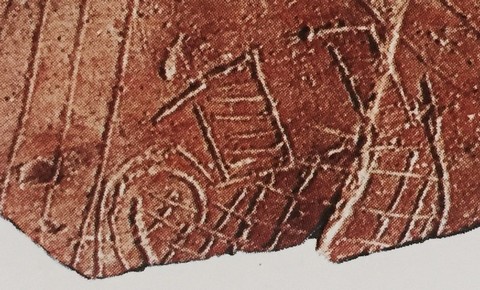
Grabac Cave on the island of Brač; Vučedol culture near Vukovar; Salona near the city of Split
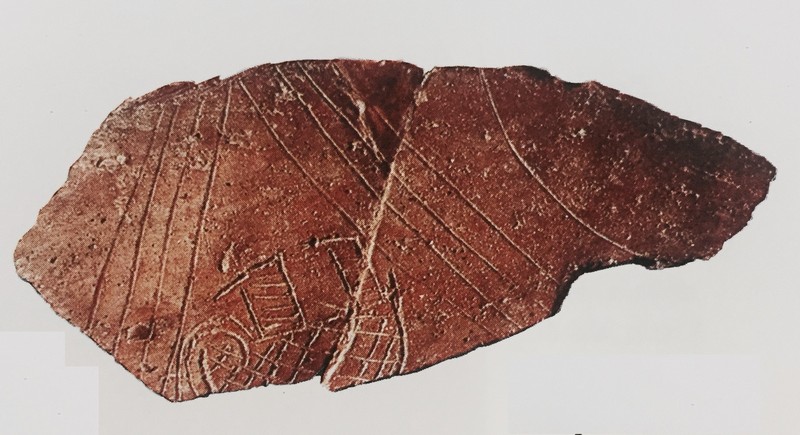
Photo from Bože Mimica: Dalmacija u moru svjetlosti, 1. Dio, Rijeka, 2004.


...the flowering of one of the
finest European artistic traditions
of the Early Middle Ages...
From his foreword to "Croatia
in the Middle Ages:
A Cultural Survey"
On the territory of Croatia there exist many remains of the Ancient Greek and Roman civilizations. Let us mention only
Very important remain of Byzantine art in Croatia is the Euphrasius Basilica in Poreč, built in the 6th century.
There are numerous traces
of much older civilizations
throughout
Croatia. Especially interesting is the Vučedol
Culture (Early Bronze Age,
3000-2200 B.C.), discovered in the
region near Vukovar,
contemporary to the Ancient Egypt (the Old
Kingdom), the Sumerian civilization,
the Old Troy.
On the photo you can see the famous Vučedol
Dove, a bird-shaped
cult vessel, lavishly
incrusted. From ornaments of some pots we know that the Vučedol
culture had the oldest
calendar
in Europe, older (though less
sophisticated) than the one in
Stonehenge. See [Durman].
Numerous
artifacts of the Vučedol culture
(including some of the most valuable) have been robbed during the
Greater Serbian aggression on Croatia in 1991. This important
Croatian cultural heritage is still in Yugoslavia.

An important monograph describing Diocletian's Palace in Split is "Ruins of the Palace of the Emperor Diocletian at Spalatro in Dalmatia" written by Robert Adam in 1764, with his main associate Ch. L. Clerisseau. The author, an outstanding Scottish architect, mentions the beauty of Split and its favorable position and climate, stating that "in the whole of the wide Roman Empire, not a single region could offer Diocletian a more marvelous place to withdraw to for a life of peace''. He designed several buildings in the style of Diocletian's palace (Syon House in Middlesex, Kedleston in Derbyshire, Adelphy Palace in London). Influences of his book can be seen even in Sankt Peterburg in Russia and in Virginia in the USA.
The octagonal Mausoleum of the Roman Emperor Diocletian was transformed into the Christian church of St Dominius (Dujam) already in the 7th century, representing very probably the oldest cathedral in the world. According to Danish scientist Ejnar Dyggve, St. Dominius (Dujam), the earliest known bishop of Salona (4th century), originated from Syria or Mesopotamia. Local Split tradition also confirms this.
It is little known that the founder of the Republic of San Marino is St. Marinus, stone-carver born on the beautiful island of Rab in the 3rd century. Being a Christian, he had to escape to Rimini with his boat due to Roman persecutions of Christians during Diocletian's time. San Marino and the Rab are fraternal towns. Every year a joint festival is held alternately in Rab and San Marino.
Another important
archeological site is Bribirska
glavica
near the town of Skradin,
where Croatian dignitaries Subic-Bribirski (later known as
Šubic-Zrinski) had their seat. The place is near the town of
Skradin. First archeological excavations were undertaken by fra Lujo
Marun, and then Stjepan
Gunjača. Settled
already
by Illyrians, during early Roman times it was called Varvaria,
and had the status of municipium. In 14th century it was
important fortress during the reign of Pavao
Šubić,
Croatian Ban (governor) and ruler of Bosnia.


One of the earliest Croatian cultural monuments is a baptismal font of Prince Višeslav from Nin (around 800 AD), with a nice interlace cross. It contains the following Latin text, full of interesting ligatures:
HEC FONS NEMPE SUMIT INFIRMOS, UT REDDAT ILLUMINATOS. HIC EXPIANT SCELERA SUA, QUOD DE PRIMO SUMPSERUNT PARENTE, UT EFFICIANTUR CHRISTICOLE SALUBRITER CONFITENDO TRINUM PERHENNE. HOC IOHANNES PRESBITER SUB TEMPORE VUISSISCLAVO DUCI OPUS BENE COMPOSUIT DEVOTE, IN HONORE VIDELICET SANCTI IOHANNIS BAPTISTE, UT INTERCEDAT PRO EO CLIENTULOQUE SUO.
Croatian translation:
Ovaj izvor naime prima slabe, da ih učini prosvijetljenima. Ovdje se peru od svojih zločina što su ih primili od svog prvog roditelja, da postanu kršćani spasonosno ispovijedajući vječno Trojstvo. Ovo djelo pobožno učini svećenik Ivan u vrijeme kneza Višeslava, i to u čast sv. Ivana Krstitelja, da zagovara njega i njegova štićenika.
Lit.
Ante Uglešić: U potrazi za
Višeslavovom krstionicom / In Search of Višeslav Baptistry,
Muzej hrvatskih arheoloških starina, Split 2022. Summary in
Croatian and English


A special
importance have about 150 Pre-Romanesque Croatian churches (9th to 11th
century), mostly along the coast. About 15 of them are well preserved
(some of them completely destroyed during the Greater Serbian
aggression in 1991-1995). Probably the best example of old Croatian
church architecture is the Pre-Romanesque Chapel of Holy Cross in Nin
built around 800 AD (Sveti Kriz; see on the right; on the left is the
small church of Sveti Nikola). The British architect Thomas Graham
Jackson called it in 1887 the smallest
cathedral in the Christianity,
because of its monumental architectural conception.
An unofficial estimate claims there are about 10,000 fragments of interlace sculpture scattered all over Croatia, see [Goss], p. 32.

One of the most important monuments of the Pre-Romanesque architecture in Europe is the Church of St. Donat in Zadar (on the left) built in the 9th century. According to [Goss, p 92], a discovery of wooden beams in this monumental church, adorned with interlace, datable by carbon method to around 710, indicates that this building, often referred to as "Carolingian", was well-under construction in the course of eighth century.
The church of St. Krševan (i.e., St. Chrysogonus, see below) in Zadar was started to be built in the beginning of the 10th century, and completed at least in 975 AD (see [Iveković, p. 43]). On the same spot there used to be an older small church, dedicated (according to tradition) to St. Anthony the Abbot (or of Egypt, or the Great), founded by Egyptian hermits in the 5th century(see [ Iveković, p. 41]).
Ćiril M. Iveković: Crkva i samostan sv. Krševana u Zadru, hrvatska zadužbina iz X. stoljeća, Zagreb 1931.

Reconstruction of the church and benedictine abbey of St. Krševan
(Chrysogonus) in Zadar from the second half of the 10th century, here
shown as it looked near the end of 12th
century, in the time of the first Zadar archbishop Lampridius, when it
acquired the present form. Source [Iveković,
p. V]. The church of St. Krševan seems to be a predecessor of all grand
Roman and Gothic cathedrals, built throughout Europe. See [Iveković, p. 47].
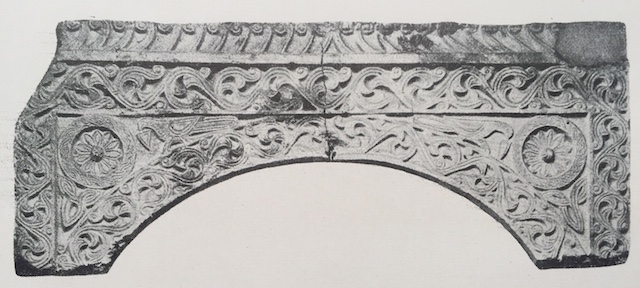
One of four arches of the cyborium above the odl main altar of the
church of St. Krševan in Zadar.

Church of St. Krševan (Chrysogonus) in the city of Zadar from the 10th
ct. Photo from 1909 (Wikipedia).
Truly fantastic stone monuments with interlace patterns were found in Dubrovnik and its environs, see [Menalo]. See also another Croatian interlace in the cathedral of St. Tripun of Kotor in Boka kotorska.
Monolithic stone grave monuments, called stechak (literally - standing tombstones), are very impressive, some of them weighing 30 tons, the earliest of them dating from the 13th century. Their overall number is more than 66,000, mostly on the territory of Bosnia-Herzegovina. There is no doubt that such monuments were put up by Catholics and Krstyans (members of a local Christian religious sect in Bosnia) during the Middle Ages. The origin of Krstyans is still not clear. Some of the stecaks have interesting decorations, some even swastika and other symbols and ornaments of eastern provenance, with epitaphs like:
written in the Croatian Cyrillic alphabet. The most widespread ornaments are Christian symbols.
Examples:


The first documents of the Croatian Cyrillic alphabet are inscriptions carved in stone in present-day Bosnia-Herzegovina dating from the 10th or 11th century (Humacka ploca) and on the Croatian island of Brac from the 12th century. They also contain some glagolitic letters. Many written documents concerning medieval Croatia contain simultaneously three Scripts, thus proving their unexclusiveness and coexistence, which is unique in the history of European culture. For example some of the religious texts end with `Amen' written three times: in the Glagolitic, Cyrillic, and Latin script. Apart from the parallel use of the three Scripts, unique is also the simultaneous use of three languages - Croatian, Latin and Church Slavonic.
Among the best artists of his time was the Croatian sculptor Radovan (born in Trogir, 13th century), who left us the beautiful Romanesque portal on the Cathedral of Trogir.
It was established by dr. Marasović that the Pre-Romanesque church of Sveta Marija in Trogir existed as early as 715-717, see [Goss, p. 88]
The wooden portal on the Cathedral of Sv. Dujam in Split carved by Andrija Buvina in c. 1214 is world famous. It is ranked among the most beautiful pieces of art in the medieval Europe.
 >
>

No doubt, the most interesting gallery in the city of Zadar is the Benedictine Gallery of Gold and Silver, which contains numerous artifacts from 11th century onward, all of them created in this ancient town. It is indeed amazing that the artifacts have been saved during the ferocious bombing by the Allies in 1943/44, when the city, a jewel of Croatian history and culture, was 90% destroyed for the reasons that we still do not know. The Benedictine convent of St. Mary, where the Gallery is situated, founded in 1066 during the reign of the Croatian King Krešimir IV (i.e. in the time of William the Conqueror), has been active without interruption till these days! For additional information about Croatian art in Zadar see here.
Some Croatian cities in Dalmatia have been described by William Wey, a teacher at Eton, during his pilgrimage to the Holy Land in the 15th century. He was impressed by Dubrovnik, Rovinj, and, especially, by Zadar where "lies the entire body of St. Simon who, in the temple of Jerusalem, carried Christ in his arms".


Lit.
Summary. The vaults of the cathedral of Šibenik (Croatia), begun in the second half of the 15th century and completed by 1536, presented a real breakthrough in the concept of construction in stone. The barrel vault of the nave, spanning 7.75 m, and the upper vaults of the aisles are constructed with thin stone slabs, fixed into slender stone arches. Due to the specific method of construction by assembling large stone panels, the structure has a specific mechanical behaviour: the stone slabs transfer the major part of their loads to the arches. Thus, the vault loads are concentrated in the supports of the arches, where the horizontal thrusts are taken by iron tie-rods. The innovative details, revealed during the recent disassembling of the dome, prompted the research on the sophisticated technique of assembling the vaults and on its possible source in the tradition of construction of stone masonry. (www.croris.hr/crosbi/publikacija/prilog-skup/614583)
Summary. The most important historical structures in Dalmatia, region in the Mediterranean part of Croatia, listed on the UNESCO World Heritage List, are the Roman Emperor Diocletian’s Palace, which marks the beginning of the monumental large-scale architecture in stone in this region, and the Cathedral of St James in Šibenik, which is the highest achievement of stone vault construction in Dalmatia. The preserved vaults of Diocletian’s Palace show variety of vault types, in variety of materials. The most interesting stone vault in the Palace is the vault of the small Temple of Jupiter. The coffered barrel vault, assembled of rela-tively large elements, influenced the form and decoration of two vaults in the nearby town of Trogir, but also the unique vaults of the Šibenik Cathedral. The thin vaults of the Šibenik Cathedral are unique for their method of construction (assembling large thin stone elements into slender stone arches) and for their mechanical behavior, different from massive masonry vaults. Although different from the vault of the Temple of Jupiter in many aspects, it is still believed that the stone vault of the Jupiter’s Temple was an inspiration for the barrel vaults of the Šibenik Cathedral. The wooden vaults “a carena di nave” have been mentioned as another possible source of inspiration. The study of recent scientific literature on various techniques of Roman vaulting brought about the new hypothesis on the possible origin of constructional details and on the development of the original building method of the vaults of the Šibenik Cathedral.
Keywords: masonry vault behavior ; light assembled stone vault ; armchair voussoirs ribs ; Roman vault ; Renaissance vault
Many thanks to Dr. Marina Šimunić Buršić (University of Zagreb) for providing the above references.

For some reason
Slovenians prefer to call him Janez, which
is Slovenian equivalent for Ivan.
By the beauty of small medieval towns and its landscape, Istria is
unique in Europe. Let us mention here, as a part of musical folklore,
the famous Istrian scale. Istria is, together with our greatest island
Krk, also the cradle of the Croatian Glagolitic
Script.
James
Joyce, Irish writer and Nobel
prize
winner, spent six months in
1903/1904 teaching English in the town of Pula in Istria,
together with his future wife. Joules
Verne placed the
story of his novel "Mathias Sandorf" in the town of Pazin in
central Istria, and in the Pazin cave. The first Naval museum in
the world was founded in Pula in 1870.
The Hrvoje missal, written by Butko in 1404, is kept in the Library of Turkish sultans Topkapi Sarayi in Constantinople, Turkey. It is considered as one of the most beautiful Croatian Glagolitic books. Note a small strawbery below. Yellow details are made of thin golden leaves.

Outstanding writer and illuminator of glagolitic liturgical books was Bartol Krbavac, born in Lika in the 15th century. His preserved books are kept in the National Library of Vienna (Roč Missal, 15th century), in the State Library of Berlin (Berlin Missal, 15th century):
in the National and University Library of Ljubljana (Beram Missal, around 1425), and in Zagreb.

Croatian Poetry in Middle Ages, by Željko Skropanić.
An unavoidable name in the history of European architecture is Luciano Laurana (Lucijan Vranjanin, 1420-1479), a Croat born near Zadar, near the lake of Vrana.

Several Early Renaissance palaces and portals had been built up in Italian cities according to his design:
He considerably influenced the development of Renaissance architecture. His projects were accompanied with notes in the Croatian glagolitic script, as witnessed by the famous Bernardo Baldi.
Lit. Lucijan Vranjanin (Croatian Encyclopaedia)Frano Laurana, known also as Francesco Laureano (1420 - 1502), a Croat born near Zadar, was a sculptor in Italy (Naples, Messina, Palermo) and in France (Aix, Marseille, Avignon, Le Mans, Tarascon). In France (Provence) he worked at the Court of Bon Roi René, and married a daughter of a French painter in Avignon. His portrait busts of women represent the highest achievement of the Quatroccento sculpture. They can be seen in galleries in Palermo, Vienna, New York and Paris (Louvre, Musée Jacquemart - André). His disciple was the famous Donato Bramante. See [Gregory Peroche], p. 72.

In the Musée du Louvre in Paris (l'aile Déon) dedicated to Italian sculpture of Quattrocento, two Croatian artists are represented, Francesko Laurana and Giovanni Dalmata de Trau (Ivan Duknovic from Trogir). Their 4 sculptures and bas-reliefs can be seen in the first hall. It is interesting that Renaissance art appeared in Croatia about a hundred years earlier than in France. See information about the exhibition La Renaissance en Croatie at Musée national de la Renaissance in Paris in 2004.

Juraj (Giorgio) Spavento was an important 15th century builder in Venice, whom chronicler Marin Sanuto called homo di grande inzegno. He was a protomaster in construction of the Venetian bell-tower of basilica of St Marco. He participated in building of monumental Scale dei Giganti in Ducal Palace, and was involved in questions of regulation of a canal around Ponte dei Navi in Venetian arsenal. Italian historiography seems to be reluctant to stress that his birthplace was the city of Trogir.
Sacral paintings of Blaž Jurjev Trogiranin (known as Blasius Pictor, ~1412 - 1448) are held not only in various churches in Croatia - in Zadar, Šibenik, Trogir, Kaštel, Split, Korčula, Ston, Dubrovnik, but also abroad - in the People's Museum in Budapest, Museo Correo in Venice, People's Gallery in Warszaw, Luxemburg. He was familiar with the Croatian Glagolitic Script, which we know from his short note written on the polyptych that he prepared for the church of St. Lovro in Trogir.
Blaž was born in the Croatian region of Lika.
Professor Miklos Boscovits, art historian from the University of Florence, Italy, contributed much to our knowledge of Blasius' works of art kept outside of Croatia.
Juraj Čulinović (1435-1504), Croatian Renaissance painter, was active in his native town of Šibenik. Except in Croatia, his polyptichs are kept also in Torino, London (National Library), Berlin and Venice.
Feliks Petančić was the last head-master of the famous scriptorium in Buda (part of today's Budapest) until the death of Matija Korvin in 1490. He was a Croat born in Dubrovnik around 1455, and he died after 1517. He entered the history as a scribe and a painter. As a miniaturist he portrayed many Turkish sultans and high court officials in his parchment rotulus called Genealogia Turcorum Imperatorum (started in 1502). His another work is Historia Imperatorum regni Turcici (1502) that is held in the municipal library of Nürnberg in Germany. This book represents the first history of Turkish Empire written in Europe. Petancic's masterpieces belong to highest achievements of Central European Renaissance miniature.
The famous German painter Albrecht Dürer (1471-1528) left us a very nice drawing from 1528 representing coats of arms of Dalmatia and Croatia. See [Gregory Peroche], p. 270.
Hektorović's palace on the island of Hvar (near the city of Split) is the most imporatant building in Stari Grad, an interesting town on the island. Petar Hektorović (1487-1572), Croatian poet and writer from Stari Grad (Old City) on the island of Hvar, is considered to be one of fathers of Croatian literature. His most important work is "Ribanje i ribarsko prigovaranje", ie. "Fishing and Talks with Fisherman", published in Croatian language in 1568. It represents the first realistic poem in Croatian literature. His fortress-home, also called Tvrdalj, which he designed himself, was built in the course of 40 years by native builders, under his supervision. Especially interesting is a fish-pond in the Renaissance garden of the fortress, and about a dozen of decorative inscriptions carved in Latin language on its walls.
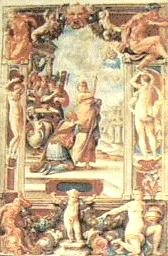

Julije Klović, or Don Giulio Clovio de Croatia (1498-1578), is regarded as the last great representative of the classical European miniature. His works decorate many famous galleries: Uffizi in Florence, Museo di Capodimonte in Naples, Biblioteca Marciana in Venice, Galleria Sabanda in Torino, Bibliothek der Albertina in Vienna, Louvre in Paris, Towneley Public Library and Pierpont Morgan Library in New York (which is in possession of "Officium Virginis", 228 pages, his most famous and the best masterpiece, containing 30 valuable miniatures by his hand), the British Museum and Soane's Museum in London, Windsor Castle (Royal Library), Library of the John Rylands University in Manchester.
His pupil was El Greco, who portrayed him in his work "Expelling merchants from the temple" (together with figures of Rafael, Michelangelo and Tizian, appearing on the bottom left of that work), now kept in The Minneapolis Institute of Arts (The Willam Hood Dunwoody Fund), USA.


GEORGIVS JVLIVS CLOVIVS CROATA
His grave is situated near Michelangelo's Moses in the the church of S. Pietro in Vincoli, Rome, and bears an inscription "Pictor de Croatia".

In
Klović's The Annunciation in
an ornamental broder (kept
in The
British Museum, London), he signed himself as "Do[n]
Giulio Clovio coruato",
that
is, by clearly indicating his origin (coruato = Horvat
= Croat):


Text arround the upper
border of the above self-portrait:

Iulius Clouius Croatus


Andrija
Medulić (Andrea Schiavone,
Andrea Meldola de Hiadra), (~1500-1563), a painter born in Zadar or
Nadin, started his artistic career in Šibenik and continued in Venice.
His works of art are scattered throughout Europe:

Young Andrija Medulić

Andrija Medulić (Andreas
Schiavone), self-portrait kept in
Gamäldegalerie in Vienna.
Medulić influenced Tintoretto, who stated that any true painter must possess at least one of his masterpieces. As Klovic, he also influenced El Greco, a famous Spanish painter of Greek origin. Medulic's paintings in the collection of Her Majesty the Queen.


Martin Rota Kolunić (Martinus Rota) was born in c. 1540 in the city of Šibenik, Croatia. About 1565, he was already working as an engraver in Venice, while by 1573 he became the court portraitist in Vienna. He died in Prague in 1583.

He belongs to the most significant European graphic artists of the second half of the 16th century. He is also well known for his reproductions of the outstanding masters of the Renaissance: Tizian, Michelangelo, Dürer and others. He engraved a number of portraits of important persons of his time, and remarkable geographical maps and vedutes.
He immortalized his home town Šibenik as well as his compatriot Antun Vrančić (Antonius Verantius) on his prints. On the portrait of the emperor Ferdinand Ist, the master draws the forms with a clear and steady line, separating the body from its background. This description is taken from the British Library web (for more information follow the above link). Note the title of the emperor Ferdinand Ist at the bottom of portrait by Kolunić:
German Ungar. Bohemiae. Dalm. Croat.

The city of Karlovac was built in 1579 as the first ideal Renaissance fortification in Europe (then followed Nove Zamky, Palmanova, Neu Breisach). It was bombed during the Greater Serbian aggression in 1991-95.
One of the greatest Croatian Baroque painters was Tripo Kokolja (1661-1713), born in the town of Perast in Boka kotorska (since 1945 in Montenegro).
Many beautiful Croatian Baroque paintings and illuminations can be seen on the walls of the churches in north-western Croatia (Lepoglava, Štrigova, Varaždin), created by Ivan Ranger (1700-1754). On the photo: St. Luka (Štrigova).

Quand un ami française m'a conseillé d'aller voir les églises baroques en Croatie...je n'ai pratiquement rien trouvé sur ce sujet. Cela m'a paru étrange, et j'ai cédé à la tentation...
Here we mention a French artist Charles François Beautemps-Beaupré, who prepared a superb collection of drawings of Croatian coast in his atlas entitled Reconnoissance hydrographique des ports du Royaume d´Italie situés sur les côtes du Golphe de Venise commencé en 1806 par ordre de sa majesté Napoleon. It contains 15 hand-drawn maps of various sizes, 2 sheets of coastal contours, water colour drawing.
This unique Atlas, kept in the National and University Library in Zagreb, is according to the acompanying presentation provided by the British Library (follow the above link) of outstanding artistic and scientific value, and is a contribution to the scientific, cultural and historical accounts of the Croatian coast.
Vjekoslav Karas (1821-1858): Roman Lady with a Lute, one of the most famous paintings of Croatian fine art from the middle of the 19th century... His parents were Bosnian Croats.
Other outstanding painters were:
The best Croatian representatives of `arts plastiques', acting in Paris, were:
In the fine arts of our time probably the most famous is the sculptor Ivan Meštrović (1883-1962), who created masterpieces, many of which are dedicated to the history of his motherland. You can see them in the Mestrovic gallery in Split and in Croatian capital Zagreb. He also created

His sculptures can be seen in London (Tate Gallery), Florence (in "Uffizi"), Torino, Rome, Prague (in Hradcany), Budapest, Chicago (Chicago Indians, Grand Central Park, see a postcard on the right from 1939 and two photos below), South Bend (Indiana, USA), Rochester (Minnesota, USA), Baton Rouge (Louisiana, USA) etc. He also carved a monument of the most outstanding Slovak writer Martin Kukučin (Matej Bencur) in Punta Arens (Patagonia, Argentina). Matej Bencur spent a part of his life in Croatia on the island of Brac and wrote a book about the life of the Croatian emigrants in South America.


Mestrovic's 1939 sculpture representing Croatian ban and bishop Petar Berislavić (killed by the Turks in 1520) was exhibited on the central square of the city of Trogir. During the Italian Fascist rule the sculpture was destroyed. In 1970 a replica has been installed on the same place. Petar Berislavić was a close friend to a famous Croatian writer Marko Marulić, who described his tragic death.
The grave of Meštrović was desecrated by the Serbs in his birthplace Otavice during the 1991-1995 occupation of the Hrvatska krajina region. Some of the original pieces of art from the Meštrović Mausoleum were damaged, and some were stolen and transported to Belgrade. The remains of "The Monument of Gratitude to Motherland" can be seen in the beautiful Visovac Monastery on the river Krka.
|
Autoportrait, |
Autoportrait, Zagreb, 1930
My mother with crossed hands, Zagreb, 1926 |
A young girl in prayer, 1925
Njegoš mausoleum, Montenegro |
Photos from the booklet Spomen galerija Ivana Meštrovića, Vrpolje. Meštrović was born in Vrpolje on the north of Croatia in 1883, where he spent his first year of life.
Ivan
Meštrović:
ON RELIGIOUS ART (1954),
excerpt: "...The head of that
suffering Church is Cardinal
Stepinac, my
compatriot, my dear friend, of whom I and all Croats are proud. I am
sure that our feelings are shared not only by all the Catholics
throughout the world but also by all men of goodwill everywhere who
cherish freedom of spirit..."
Please, do not miss the following deep thoughts of Ivan Meštrović, as if written today (taken from Zeljko Skropanic web site, see the complete text):
There are more and more people today who have come to the conviction that one of the main causes of the tragic events of the recent past, as well as those which loom on the horizon, is the fact that modern man has all but forgotten the great teachings of the Sermon on the Mount [The Bible, Mathew 5-7]. The blame for this rests not only on our contemporary despotism, but, unfortunately, on a long list of talented men of science and art who have not foreseen the corroding complications and destructive consequences of their doctrines. This atmosphere of unbelief, this tragic state of man cut off from the very axis which holds and moves everything, has had repercussions on all domains of human activity, including that of art, which in the most significant periods of civilization worked hand in hand with religion - an ennobling and spiritualizing factor in human life.
Christian civilization, in our days, finds itself locked in a mortal struggle with the forces of secularism in varying forms and degrees. Many people fail to realize that Christianity, by waging the fight for its principles, defends also the foundation of the democratic way of life; for the concept of the dignity of each man and the equality of all men stands and falls with the Christian view that man is created in the image of God. Thus the Church is in the front lines of the battle against the onslaughts on human freedom.
A moment ago, I mentioned my wood carving of the scene of the Crucifixion. The piece of wood on which I carved the Crucifixion has an interesting story which I would like to share with you. I was in Geneva, Switzerland, when I was seized by the desire to carve the Crucifixion. Every available oak had been bought by the factory that manufactured rifle buts, presumably for both warring sides. I had a hard time to acquire from the factory a few boards for relief. I was unable to get the whole piece of the trunk because they had all been sawed up. Finally, I discovered one trunk that had not been sawed off; it was withered and had stood with its roots in the soil and was not considered good for rifles because it was assumed that the wood was probably decayed. When I started to work on it, I discovered that it was solid and whole. The lumberman told me that it had been imported. I was surprised to learn that it had come from Croatia, my native country.
That same piece of wood was later returned to Croatia, transformed into the Crucifixion scene. Today it stands there, in a small Chapel, in the country where the Catholic Church is being crucified daily. The head of that suffering Church is Cardinal Stepinac, my compatriot, my dear friend, of whom I and all Croats are proud. I am sure that our feelings are shared not only by all the Catholics throughout the world but also by all men of goodwill everywhere who cherish freedom of spirit
In vain do the Godless and restless men, who are today making weapons in the hope of enslaving the world, think that the trunk of the Christian tree is withered. It will outlive and outlast the forces of evil in my native land and throughout the whole world. He who has conquered death will conquer the destruction of His teaching.

One of Meštrović's major works is Moses, the monument donated to the people of Israel.
Silver Proof €15 coin celebrates the 80th anniversary of the original coin design Girl with Harp which was gifted to the Irish State by Ivan Meštrović in 1927. This design was submitted by the artist as an entry in the competition for the design of the 1928 Irish Free State coinage. Unfortunately, because of difficulty contacting him (he was in the United States) his design arrived too late for consideration. The Chairman of the Design Committee, a famous Irish poet William Butler Yeats, subsequently wrote "He made one magnificent design and, on discovering that the date had passed, gave it to the Irish Free State with great generosity". It has been used as the seal of the Central Bank of Ireland since 1965. Alongside the €15 Silver Proof Coin being issued in Ireland, there is an almost identical 150 Kuna Silver Proof Coin being issued by the Croatian National Bank. Both coins bear an identical obverse, the beautiful “Girl with Harp” design by Ivan Meštrović. (source: Central Bank of Ireland)

Both Irish and Croatian coins minted by Croatian Mint.

For more information, see Ivan Meštrović Silver Coin [PDF], Hrvatska narodna banka.

The double box set limited to 2000 overall, 1000 to Ireland and 1000 to Croatia.
In 1928, Meštrović sent four recommendation letters to his influential friends in Croatia in which he asked to help the Croatian Youth Society BUNJEVAC from the city of Subotica to visit the land of their grandparents - Dalmatia and Herzegovina. As he stated, Bunjevci Croats in Bačka have preserved the character of their grandparents in their ikavian speech and customs. See "Marulić", 5/1998, 908-911.
In 2018, Ivan Meštrović's son Mate and his wife Rumjana, donated the bust of Jozef Pilsudski carved by Ivan Meštrović in 1939, to the Republic of Poland, on the occasion of 100 years since the independence of this state. The donation took place in Croatia's capital Zagreb, during the ceremony in the Glyptotheque of the Croatian Academy of Sciences and Arts, at which H. E. Andrzej Jasionowski, ambassador of Poland in Croatia, was present.

The bust was carved as a sketch of the part of the equestrian
statue, planned to be 25 meters high (Sic! Probably counting its
basement.), but the IInd World War prevented the realization of this
project. See Jozef Pilsudski
for more information. Another equestrian statue of Jozef Pilsudski was
completed by Meštrović's very talented student in Zagreb - Antun Augustinčić, which since the mid-1990s was moved from Croatia to the city of Katowice in Poland.
In 1954 Meštrović became a citizen of the United States at a ceremony conducted by President Eisenhower at the White House. See his daughter's article.
The white marble from the island of Brač, near the town of Pučišća, is highly appreciated among sculptors. It was also used in the building of
The first monument honouring Mother Teresa was carved in Supetar on the island of Brač (2002) in Croatia. It was unveiled by Martin Sheen.

Ivan Rendić (1849-1932), distinguished Croatian sculptor, author of about 200 monuments throughout Croatia and a smaller part in Trieste, Italy. Some of his works of art are exhibited at the Ivan Rendić Gallery in the town of Supetar on the island of Brač. Ivan Rendic.
Lit. Ivan Rendić
Jozo Kljaković (1889-1969) is distinguished Croatian painter and illustrator. His paintings and murals are mainly of religious content. Kljaković is best known for his frescos that he painted in the church of St. Mark in Zagreb, in the parish churches of Vranjic (near the city of Split), in Dobrota (in Boka kotorska), and in the memorial church in Biskupija near the town of Knin, as well as for his mosaics in the Pontifical Croatian St. Jerome Institute in Rome. He left Croatia in 1943, and spent the following 25 years in Rome and Buenos Aires.
It will be interesting for Russian readers to know that the earliest monument built in honour of the famous writer L. N. Tolstoy (1828-1910) was erected not in Yasnaya Polyana, but in Selca (1911, a year after his death), a small and lovely town on the island of Brac, which has a great tradition in stonemasonry.

In the beautiful stone church in the town of Selca on Brač, there is Meštrović's bronze statue of Jesus Christ, with a heart in his hand - symbol of love and peace. This statue, a gift of Ivan Meštrović, was made from large amount of artillery shells left by German troops on Brač after the WW2.
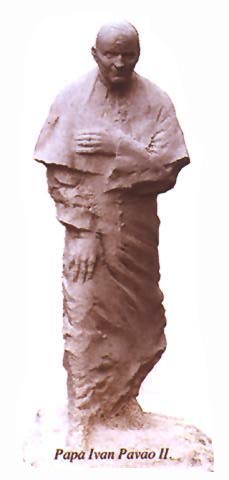
In
1996, Selca
erected a monument to a great pope,
John Paul II,
out of gratitude for his concern for the Croatian people.

I like very much Gabrijel Jurkić (1886-1974), a little known Croatian painter from Bosnia - Herzegovina, who studied at the Academy of Arts in Vienna. If you come to Sarajevo, don't miss to see his beautiful "Flower plateau" (from the Kupres area) painted in 1914, held in The Art Gallery of Bosnia - Herzegovina in Sarajevo. See on the left, and many more on Croats in Bosnia - Herzegovina. Biography of Gabrijel Jurkic (in Croatian).
Mila Wod (1888-1968, yes - Wod, not Wood) is the
first Croatian women-sculptor. In 1929, she carved the monument of Stjepan Radić, since 1936
exhibited in the town of Petrinja. It is the first public monument
carved by a woman, as well as the first public monument dedicated to
Stjepan Radić (assassinated in the Belgrade Parliament of ex-Yu in
1928). Mila Wod is an author of
very nice decorations adorning the former building of the National and University Library in
Zagreb (now the Croatain State
Archive,
at Marulić square in Zagreb). Her works of art can be seen in the
parish church in city of Metković.
Lit.
Croatian painter and muralist Maximilian (Maxo) Vanka (Zagreb 1889 - Mexico 1963) completed his studies at the Academy of Fine Arts in Zagreb, where later he became professor of painting. He also studied at the Brussels Academy of Fine Arts, Brussels, Belgium. As a young student he exhibited at an international show in the Belgian capital and in 1914 won the gold medal of King Albert at this event, for his Bistrički proštenjari (Marija Bistrica fairgoers) with beautiful Croatian folklore motives. He made a nice portrait of distinguished Croatian female composer Dora Pejačević (1885-1923):

Vanka exhibited throughout Europe, and obtained many honours, among them Palme Academique of the French Legion of Honor. Having moved to the USA in 1934, he became noted for his beautiful church murals, for example in St. Nicholas Croatian Church, Pennsylvania. Some american specialists consider these murals the best church frescos in the USA. He depicts not only traditional Catholic scenes and symbols, but also the lives and spirituality of the Croatian immigrant community.


According to Croatian art historian Nikola Vizner, most of his works are in possession of his family in Bucks County, Pennsylvania; the Michener Museum in Doylestown, PA has a formidable collection of his works; there is a large collection of his work in Modern Gallery, Zagreb, Croatia, as well as in the Memorial Museum Maximilian Vanka in the town of Korcula (on the beautiful island bearing the same name), Croatia. Here is Vanka's philosophy of painting:
|
I
painted so that Divinity in
becoming human,
would make humanity divine. |
His main interests were in folklore and social motives, human destiny in general. One of his deeply moving masterpieces is Lepers, a result of his short stay in India.
From Pitsburgh History (an excerpt): In Millvale, at St. Nicholas Croatian Catholic Church, one very unusual wall mural blends religious and political themes to express a strong personal message from its artist, Maxo Vanka, a Croatian artist who fled to the U.S. in the mid-1930's. On the ceilings and walls of St. Nicholas, Vanka painted Jesus' mother weeping at the Crucifixion; a Croatian mother weeping as she raises her sons for war; an immigrant mother weeping as she raises her sons for hard labor in the manufactories; and the famous statue of Injustice wearing a gas mask. On the ceilings below the choir loft he painted images of war, mixing images of Christ with 20th Century soldiers, and at the back, a greedy capitalist sitting at a table ignoring a beggar at his feet.


The controversial commentary on social classes and injustice sparked debate at the time, and a prominent Pittsburgh family even offered one million dollars to the Diocese to whitewash what they felt was a personal attack. The offer was refused, and today the controversial images still exist along with Vanka's more pastoral images depicting rural life in a Croatian village. In those less provocative mural images, people are dressed in traditional Croatian costumes, and they dance by a sea that "flows" into the hills of Pittsburgh, surrounded by a painting of the parish priest and the immigrants who helped to build the church.

Maxo Vanka told the story of Croatia's tragic heroes through war, and immigration, and work on the walls of St. Nicholas Croatian Catholic Church in Millvale. These murals are definitely not just for decoration like the murals in homes. What story do they tell? See here.

But more amazing are the political murals that echo the crucifixion. Widows mourn over a soldier in a coffin containing a bleeding corpse; crosses cover the hillside behind them. Another wall depicts a corrupt justice in a gas mask holding scales on which the gold outweighs the bread. Clearly World War II had a big effect on Maxo.
The Virgin, on the verge of being bayoneted herself, separates two soldiers.

On another mural an oligarch done as Death reads the stock reports while being served a chicken dinner by two black servants.
One more: Jesus is stabbed, a second crucifixion.

These are badly in need of renovation; probably years of coal dust have darkened them. But one can hope that these amazing things will survive and be cleaned soon.
St. Nicholas was established as a Croatian parish in 1900. The origin of the parish can be traced to the influx of Croatian immigrants to the area to work in local industries in the late nineteenth century...


Church murals depicting spiritual, cultural lives of Croatian immigrants draw renewed attention


Peggy Vanka Brasko: It was well known that my father [Maxo Vanka] worked at painting the murals at a furious pace. He usually worked between 16 to 18 hours daily through the entire week. He worked without a watch so as not to be influenced by the time of day. ...

The Murals at St. Nicholas Parish: ...Today they stand as a moving tribute to the people of Croatia, the Croatian immigrant and all immigrants to the United States. They are among the most striking and provocative murals found anywhere in the world. Maxo Vanka's twenty murals, combined with a more contemporary and complimentary mural by J I Knezevich, form a unique church artwork that combines secular and ecclesiastical images with startling interpretations of 20th century historic events.
Maxo Vanka was a good friend to Andrija Stampar, a famous Croatian phisician, father of the World Health Organization (WHO).
You can
support the work
to preserve the murals through
the Society to Preserve the Millvale Murals of Maxo Vanka.
Please write for more information to:
The Society to Preserve the Millvale Murals of Maxo Vanka
c/o Diane Novosel Chairperson
151 Stone Gate Drive
Leechburg PA 15656-7228.
Personal and group tours of the murals can be arranged by calling:


One of the symbols of the United Nations that everybody knows is the Horsewoman (the Monument of Peace), a sculpture created by Antun Augustinčić (1900-1979). It was given as a gift to the UN and it is situated in front of the main building in New York. The basement of the monument is made of the marble from the Croatian island of Brač. The equestrian statue was cast in the city of Zagreb, capital of Croatia.

The Monument of Peace has 10 m high stand and 5.5 m high equestrian sculpture. Another beautiful equestrian statue that Antun Augustinčić created represents a Polish marshal, Jozef Pilsudski.

The monument was commissioned before WW II, and was supposed to be delivered in 1939. It was delivered only in mid 1990s, and is now in Katowice, Poland (many thanks to dr. Maciej Paluszynski, Wroclaw, for this information).


Augustinčić
studied in
Zagreb and Paris, and except in these
cities had exhibitions in London and Barcelona. He carved a bust of a
famous Croatian violinist Zlatko
Baloković
in 1967 (Zagreb, Mirogoj). Among his professors at the University of
Zagreb was Jozo Kljaković,
distinguished painter.

Grave of Zlatko Baloković
(distinguished Croatian violinist) in the Mirogoj Cemetery in Zagreb,
carved by Antun Augustinčić. Photo by Nikola Piasevoli, Zagreb.
The Charter of United Nations deals with human rights. Regarding basic human rights, we invite you to read a message of a Croatian Minister to those going to war from 1778, and due to its excellency translated into German, Dutch (in the Hague!), Swedish in 1778, and into Latvian in 1804.
Zdenka Sertić (1899-1986), Croatian painter and ethnographer, collaborated in various journals, lexicons, and enciclopaedias as a graphic illustrator specilized in Croatian folklore, in particular in national comstumes and customs. She had exhibitions in Paris, Leipzig, Barcelona, Berlin, Haag, Bruxelles, Kopenhagen, etc.

Kristian Kreković (1901-1985), outstanding Croatian artist, born in the village of Koprivna near Tuzla in Bosnia - Herzegovina, in the family of forester from Croatian region of Lika, died in Palma de Mallorca. He studied in Vienna and Paris, and already since 1928 was a member of the French Society of Visual Arts. The same year he was awarded the gold medal in Bordeaux (Exhibition of international art). Krekovic portrayed many ministers, statesmen, and outstanding persons like

His extensive opus of 143 large format works, devoted to Croatian history, including 63 portraits of Croatian Dukes and Kings (from Porga from 620 till Stjepan Tomasevic in 1463), was unfortunately not preserved. Between 1928 and 1966 he visited Peru many times, so that his work became deeply imprinted by the life and art of Incas. Since 1955 he lived in Peru, and accepted Peruvian citizenship offered to him. He had great success with exhibitions of
(that is, Present and past of the fabulous Peru) in
In the course of Kreković's first exhibition in the USA (held in New York) he was described as "Yugoslav painter". Krekovic did not permit such misrepresentation, and warned the organizers that he would not allow the exhibition to go on if he were not described as Croatian-peruvian painter. He succeeded, despite the protests from the embassy of ex-Yugoslavia.
It is not surprising that he is often described as Croatian born Peruvian artist, or as Poeta de la pintura. Kreković signed himself as pintor croata or pintor croata-peruano. His grand exhibition of ethnographic paintings held in 1954 in Lima, was opened by the president of the state.

In 1966 the famous Peruvian city of Cuzco (or Cusco), the old capital of The Inca Empire and "The archaeological capital of South America", conceded him honorary citizenship and the Gold medal of the city.
Since 1965 he settled in Palma de Mallorca, where in 1977 he built the Museum of Palma de Mallorca with his works of art, now known as Museu Kreković (Collección Pintor Krekovic). The Kreković Museum was officially opened in 1981 by the Spanish Queen Sophia. In the guestbook she wrote:
The Spanish Queen is also the honorary president of Kreković's gallery.
The following fascinating work is entitled Exodus of the 20th century. Note that all races are represented, with a couple in Croatian national costumes on the right (in fact his auto portrait and portrait of his wife Sina). Also, the far right person represents a Jew with a typical Jewish cap.


Mahatma Gandhi, who was a personal friend of Kristian Kreković (see [Gaspar Sabater, pp. 38 and 54]), wrote the following:
El sentimiento de Kristian Krekovic hacia el mundo es único. Impregna todo su arte e impregna con extraordinario creatividad y constructivo carácter.
Manuel Vegas Castillo, Director of Culture of the Peruvian Ministry of Education:
Kristian Krekovic, the Croatian-born artist, has dedicated his life and his Art to the fabulous Empire of Incas, Pre-Incas and present day Hispano-American Folklore, with such prodigality of love and truth, art and knowledge, force and sensuality, sacrifice and perseverance, the likes of which have never been equaled by any other painter in the artistic history of America.Over the long years when I had the honor of directing and guiding the culture of my country, I have been able to observe the superhuman efforts made by Krekovic who visited museums all over the world to study the New World archaic cultures and to paint in their collections the precious textiles, pre-Columbian jewels and adornments for his paintings. I was also an exceptional witness to his expeditions in the native regions of the Andes to heights around 10.000-12.000 feet [3-4.000 meters], in order to seek out and paint the purest and most representative types of the Aboriginal race, there on the spot.
The splendid Kreković collections enjoys its great prestige because it is the only in the world which presents the Art and Culture of the South American Indian that legendary bronze race of the Incas, with such astonishing and brilliant results, excellence in picturing, strongest historical and scientific authenticity, creative imagination and magnificent interpretation. The whole undertaken and realized by one single man. This explains the enormous success, endorsed by the critics, which his exhibitions have enjoyed in the most important cultural centres of Europe and U.S.A.
Krekovic's paintings are such expressive compositions, and almost three dimensional. His brush-strokes are definitive, his colouring luminous. He cannot be classed among any existing Schools, he is quite unique and apart. His Peruvian work has no equivalent, and occupies a special place, not only in the artistic history of Peru, but in the Art of all time. Nobody can visit his collection without being profoundly impressed by it.
For his artistic merits the Peruvian Government has granted Mr. Krekovic the "Order of Merit for distinguished Services" and furthermore the President of the Republic of Peru has patronised his exhibitions all over world, a most exceptional distinction.
BARCELONA; "La Vnaguardia Espanola": Juan Coretés, 1957.
"...as sensational, without any exaggeration, can be qualified the exhibition brought to us by the Croatian-born Peruvian artist Kristian Krekovic. His, for the most part monumental paintings are masterly and complicated composition, with absolutely perfect drawing, masterly treatment of chiaroscuro and brilliant and luminous palette...".
The above two texts are taken from the prospect Kreković Collection, Palma de Mallorca (many thanks to Mr. Vladimir Novak for this and related materials).
Es
uno de los más grandes pintores de
todos los tiempos.
Camille Mauclair, see [Gaspar Sabater,
p. 45-46]
Krekovic used Croatian Glagolitic script in daily correspondence with his friend Marko Dosen (president of Croatian Parliament during the WWII period), as was the custom also in his family during his childhood. His wife was Sina, a Frenchwoman who mastered Croatian language perfectly, using many Croatian expressions and words already expelled during the Yugoslav period. Born in Paris in 1910, daughter of outstanding surgeon, she spoke also Quechua, Catalonian, Spanish, Italian, German (studied piano at the Vienna Conservatory), French, Russian, and English. Krekovic dreamed about free Croatia, and to start again working on his Croatian cycle, but he died too early. It is worth mentioning that in 2002 Javier Bizarro Bentitz won the prestigious "Premio de Poesia Antonio Machado" with his poem Los fantasmas del Parque Kristian Krekovic, among 154 other works.
We mention the monograph Kristian Krekovic. El artista y su obra (1997) written by Gaspar Sabater and published in Spain. The Master thesis (Mémoire de Maitrise) under the title Kristian Krekovic was defended by Ingeborg Möller Rizo at Universidad Cluny Espana (CLUNY ISEIT) in 1974., based on personal interviews with Sina Krekovic, wife of Kristian Krekovic.
Kristian Krekovic
Espacio dedicado exclusivamente a la exposición de la obra del artista croata Kristian Krekovic, instalado en Mallorca desde 1965 hasta su muerte en 1985. Presenta además algunas piezas de artesanía popular de Perú, país donde también residió el pintor.
"Poeta de la pintura" llamó a Eulogio Díaz del Corral el pintor croata Kristian Krekovic.
Oscar Nemon (1906-1985), outstanding sculptor and medallist, was born in Croatian town Osijek, and has Jewish roots (Oscar Neumann). Having obtained his baccalaureate in Osijek, in 1923 he moved to Vienna. He was inspired and supported by Ivan Mestrovic, a great Croatian sculptor.
In 1931 Nemon made a portrait of Sigmund Freud in person, for which Freud said to be "...a very good and astonishingly lifelike impression of me". After a short stay in Paris, having obtained bursary from his native city of Osijek, he went to Brussels in 1925, to study at the Academie des Beaux Arts. He stayed in touch with Osijek, and made for the city the monument "June Victims", commemorating the murder three Croatian members in the ex-Yugoslav Parliamnet in Belgrade in 1928, among them Stjepan Radic. In Burssels he made busts of King Albert I, Queen Astrid, and Auguste Vermeylen, a notable historian of the Flemish School of Painting.

Oscar Nemon portraying Sigmund Freud in 1931, source
In 1938, due to the Nazi invasion of Belgium, he fled to England, and lived in Oxford. During the WWII a larger part of his family perished in the Holocaust, including his mother and brother. In subsequent years he made sculptures of many distinguished persons, like Winston Churchil (in 1965, upon the invitation of the British Government, and on the occasion of his death), Queen Elizabeth II, Queen Mother (upon her request), Dwight Eisenhower, Harry Truman, Viscount Montgomery (of Alamein), Harold Macmillan, Margaret Thatcher, etc. It is interesting that Winston Churchil in return made his amateur sculpture of Oscar Nemon.
His obsession was an architectural utopian project of Universal Center of Ethics.
In 1981 Nemon made a bronze relief for Canterbury Cathedral. His last major work was a National Air Force Memorial for the city of Toronto, Canada, unveiled by The Queen in Toronto in 1984.
For his exceptional achievements the University of St. Andrews in 1977 conferred Oscar Nemon an Honorary Doctorate of Letters. On the occasion of his death, a memorial retrospective exhibition of his works was organized in 1985 in Croatia, in his native city of Osijek.

Oscar Nemon's sculpture of Churchill and Churchill's sculpture of
Nemon.
They sculptured each other simultaneously.
Source oscarnemon.org.uk
Some web pages wrongly indicate that Nemon was born in (ex) Yugoslavia, which at that time did not exist. Nemon was born in Croatia, then a constituent of Austria-Hungary.
Josip Crnobori (1907-2005)
Gustav Likan (1912-1998) was distinguished Croatian painter, born in the region of Lika (a part of Croatia on the north of the mountain of Velebit), in the village of Srb. He completed his primary school in the town of Gospić, and grammer school in Croatia's capital Zagreb. He got his first employment in the Discount Bank (Eskomptna banka) in Zagreb. However, his painting talent was soon recognized in Zagreb by Robert Auer (professor at the Academy of Arts). He wen to Munich (Germany), where he was proclaimed as a "honrary student".
After living in Rome, Amsterdam and
Paris, he returned to his native Croatia in 1936. He exhibited in
München, Berlin, Paris, Amsterdam, Copenhagen, Odense, Aarhus,
Gothenburg, Oslo, Stockholm, Vienna, Bratislava, Salzburg and Split,
while in Zagreb he had several exhibitions in the period of 1932 to
1944.
After WWII, he emmigrated to Austria. Since 1950 he lived in Argentina, where upon the personal invitation of Eva Perón, he painted great many murals in Buenos Airesu, Mendoza, Cordoba, Corrientes, Tucumano, Rosariju, Termal de Reyes, San Juan, Salti i Formosa. His best known murals are painted for children's hospital in Termas de Reyes in San Salvador de Jujuy, which subsequently was transformed into a luxorous hotel for rich people.
In
1957, he moved to
Chicago, where he made
portrats of several notables, like of Conrad Hilton (the founder of
Hilton hotel chain), of the president of the USA Herbert Hoover,
Chicago archbishop cardinal Samuel Stritch, etc. His "American Tragedy"
dealing with the family of Kennedy, is exhibited in the Presidential
Library of L. B. Johnson, and is known throughout the USA.
He had his first exhibition in Chicagu in May 1959, and then in New York, Denver, Los Angelesu, Sacrament, Atlanta, Toluca (Mexico), Austin, and elsewhere. It is worth noticing that „Vincent Price Museum” in Los Angeles bought 250 of his works of art and drawings. Gustav Likan made portraits of Aloysius Cardinal Stepinac and of Ivan Mestrovic. He described his life in his book „The Life and Times of Gustav Likan, Collected Anecdotes”.
According
to Robert Merrill
Chase: "... He has
long been noted in Europe for his portraits of royalty and heads of
state. Since coming to America, his color genius...caught fire and he
emerged as one of the most important colorists of the twentieth
century. Considered a prodigy, Likan won early acclaim in academic
circles. So great was his grasp and talent, he flew through the
ordinarily rigorous years of required draftsmanship and human figure
drawing in half the usual time. Recognizing his extraordinary
talents, the Munich Academy of Fine Arts bestowed the special honor
of ... Displaying 750 of 3266 characters."
Lit. Dr. Ante Čuvalo: Gustav Likan
Boris Plenkovich (1913-1976), a graduate from the National Academy of Fine Arts, USA, has painted portraits of Woodrow Wilson, Abraham Lincoln, Franklin Roosevelt, and the late John F. Kennedy and Mrs. Kennedy. His large painting, Christopher Columbus Discovers the New World, was accepted by the Congress of the United States and hangs in the Capitol Building. His other works, kept in the Library of Congress, include Christ, Christ at the door, and Adoration (source).
Lit. Francis H. Eterovich and Christopher Spalatin (eds.): Croatia / Land, People, Culture,
Volume II, Toronto Press, 19170, p. 439
Oton Gliha (1914-1999) depicted through his paintings his poetic impressions about hundreds of kilometers of dry stone walls called GROMAČE, built on numerous Croatian islands during many centuries. His very original style, based on the unique texture of the gromace, attracted considerable interest during exhibitions in Venice (the bienalle), Sao Paulo, Torino, Milano, Genova, Paris. Some of his paintings are held in the Tate Gallery, the Guggenheim Museum, also in Sarajevo, Ohrid, and in the building of YU government in Belgrade. The solemn curtain of the National Theatre Ivan Zajc in the city of Rijeka is based on the gromace landscape, which is very typical for the nearby largest Croatian island of Krk. Gliha's art reveals an intimate relation between gromače and the structure of the Croatian Glagolitic Script.
Virgilije Nevjestić is one of today's greatest graphic artists, a professor in Paris (since 1977 at the "Institute for the formation of restorers of works of art'', and also the chief of the ``Atelier for artistic technology''). His masterpieces are in possession o many private collections, including a collection of Georges Pompidou, a former president of France. One of his famous large-scale paintings is Vukovar, which he described as a scream, revolt against an evil done to the Croatian people.
Zdravko Dučmelić (1923-1989), outstanding Croatian artist born in Vinkovci, studied painting in Zagreb, Rome and Madrid (Real Academia de San Fernando), and in 1949 emigrated to Argentina. From 1963 to 1966 he was director of Escuela Superior de Artes de la Universidad Nacional de Cuyo.

Zdravko Dučmelić, self-portrait
Dučmelić masterfully illustrated a famous book "Laberintos", written by Jorge Luis Borges (Ed. De Arte Gaglianone, Buenos Aires, 1983), with his surreal, quasi-metaphysical works (...el pintor preferido de Borges).

He also made various portraites of Borges that were exhibited in 1987. In 1980, Dučmelić has been invited by Argentienan Ministry of Foreign Affairs (Ministerio de Relaciones Exteriores) to realize expositions of his works in several museums in Japan: in Tokio, Kyoto, Aomori and Kamatura.
 |
 |
 |
 |
He also had exhibitions in Panama, Peru (Lima), Chile (Santiago), Mexico, Cuba (Habana), Canada (Ottawa) and China (Bejing). In 1983 he had exhibitions in his homeland, in Zagreb and Rijeka. For more information see El Golem and Arroyo.
An
interview with Dučmelić in Croatian has been
published in Hrvatska
revija: Razgovor
sa Z. Dučmelićem. Hrvatska
revija. 38
(1988) 4. - 651-668.
One
of his works of art has been bought by Henry
Kissinger (Hrvatska revija. 32 (1982) 1, p. 129.).
Josip Turkalj
(or Joseph Turkaly, 1924-2007)
sculptured numerous works that are found throughout America in private
collections and public places. Suffice to mention a few: an
eighteen-foot bronze Moses on the campus of Notre Dame, two marble
statues of Mary (Our Lady of Peace and Our Lady of Bistrica) at the
National Shrine in Washington, D.C., a bronze statue of George
Washington in the city of Buffalo, also the statues of St. Paul
(Croatian church in Cleveland), Cardinal Stepinac (Croatian Home, East
Lake, Ohio), St. Francis' Stigmata (Windsor, Ontario), Immigrant Mother
(Toronto, Buenos Aires, Zagreb), etc. His works are also found in:
Worthington and Duluth, Minnesota; Gary, Indiana; Dubuque, Iowa;
Rochester, New York; Villa Maria, Pennsylvania; Detroit, Michigan; St.
Thomas, Ontario, and many other public places. (This is an excerpt from
an article by Dr. Ante Čuvalo,
USA). See www.turkalyart.com.
Dušan Džamonja (1928-2009) is an avant-garde sculptor whose monuments can be seen, besides in Croatia and Bosnia-Herzegovina, also in public areas in Austria, Switzerland, Belgium, France, the Netherlands, Italy, the USA, and in the new Yugoslavia. As a means of expression he uses iron, glass, concrete etc. In 1998 he had a great retrospective in Paris (Place Vendome).
Ante Starčević
(1933-2007) is a distinguished Croatian sculptor and painter. He is
best
known for his sacral opus preserved in various Roman Catholic churches
in Croatia and in Bosnia and
Herzegovina. He is a descendent of the family of the Father of
Homeland (Otac Domovine) dr. Ante Starčević (1823-1896), Croatian
historian and politician.

Ante Starčević; source: from the film by Jakov Sedlar indicated below.
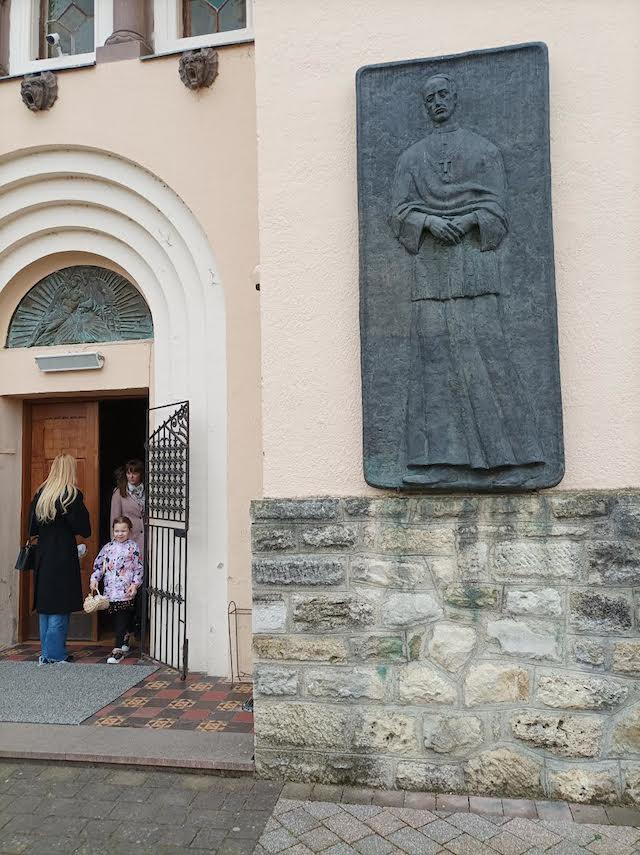
Bronze relief by Ante Starčević appearing near the main entrance to the
Krašić parish church,
representing Alojzije Stepinac.
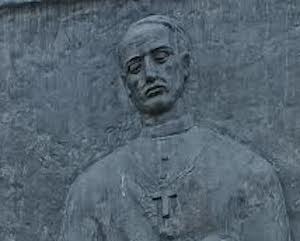
Portrait of Alojzije Stepinac from the above relief

Eighth Station of the Way of the Cross in Croatian National Sancturay of Marija Bistrica,
carved by Ante Starčević in 1990.

The doors of the baptestry of the Cathedral of St James in Šibenik (15-16th centuries)
were created by Ante Starčević.
Zvonimir Mihanović, born in 1946 near the city of Split, achieved worldwide fame for his poetic paintings of peace and tranquility along Croatian coast, drawn with breathtaking precision.
In 1978, he was awarded the grand prize of the prestigious Salon d'Automne in Paris. In 1996 his work was exhibited in the Croatian Pavillion at the Atlanta Summer Olympics.
Dimitrije Popović held three exhibitions in Rome as a part of Vatican's celebration of Grand Jubilee to mark 2000 years of Christianity. These exhibitions are also part of the project "The Way and the Holy Land (Rome - Jerusalem)". Paintings within Popović's cycle Corpus Mysticum are devoted to Jesus Christ and his crucifixion. Born in Montenegro (1951), he graduated at the Academy of Fine Arts of the University of Zagreb. In 1982 he exhibited in Pforzheim with Salvador Dali.
Ante Dabro, born in Croatia in 1938, began carving as a shepherd. His talent was first noticed during his childhood, when he carved a dove so precisely, that his cat jumped on it. He studied under Antun Augustinčić in Zagreb.
Not agreeing with communist Yugoslavia, since 1967 he lives in Australia, where he became one of the most outstanding sculptors. He exhibited in many european cities, and his work is especially esteemed in London. Some of his most important works include Royal Australian Navy Memorial (see also here and here; opened by Queen Elisabeth II in 1986, placed near the Australian Parliament in Canberra), La Perouse memorial in Paris (built in honour of an 18th century French explorer and naval officer Jean-François de Galoup, Comte de La Pérouse; ordered by the French Ministry of foreign affairs, placed about 200 meters from the Eifel tower). In 1999 the ANU (Australian National University in Canberra) Drill Hall Gallery held a major survey exhibition of his work, celebrating 30 years of his activity in Australia.
In his short biography presented at the School of Arts of the Australian National University, where he lectures, we can read the following: While he supports contemporary changes in art, Ante remains a passionate guardian of traditional artistic conventions.
Velimir Trnski, oustanding Croatian painter, born in 1947, completed the Academy of Fine Arts of the University of Zagreb. In love with Flemish art, since 1980s he lives in Paris..
Velimir Trnski, top Croatian painter, "paid tribute to Katarina Zrinski née Frankopan (17th century), the young widow of Petar Zrinski, but seen, and painted, from a (post)modern sensibility angle" (Darko Glavan, art historian).
Velimir Trnski: Art meets Justice at Eurojust - Croatian Presidency of the Council of the EU 2020

Charles Billich is outstanding Croatian painter born in 1934 in the town of Lovran in Istria, and since 1956 working in Australia. He has permanent exhibition of his works at Hakane Museum in Tokyo since 1997, and was designated the official artist of the Australian Olympic team for Olympic Games in Sydney in 2000. I like his Canberra cantata. In 1998 Charles Billich completed his series of Bleiburg paintings. He was elected the official painter of Australian and the USA national teams at Olympic Games in Greece, 2004. In 2004 he was elected the Official Artiest of the 2008 Beijing Olympiad. Laureate of the Milan & Spoleto Award, Italy, in 1989. His most famous galleries are Billich Gallery in Sydney (100 George Street), Australia, and Fortezza Gallery in the lovely town of Lovran, Croatia. In 2004 he had the exhibition of some of important Croatian contributions to science, held in the building of United Nations in New York, which consisted of portraits of
Charles Billich Collections (incomplete):
Davor Vrankić, distinguished Croatian painter living and working in Paris and New York, uses the motives of interlace patterns from the north of Croatia (more precisely, from his native Slavonia) in his extremely complex and intricate artistic compositions.
Naive art is quite widespread and highly esteemed. The first steps were undertaken by the painter Krsto Hegedušić (1901-1971) in the Croatian village of Hlebine. It was the famous Hlebine school. Hegedušić also founded a group of artists called "Zemlja" (Earth) in Zagreb in 1929, which has been forbidden by the Yugoslav (Serbian) police in 1935. From a large number of naive painters, whose creations decorate private and state collections from Paris to Tokyo, let us mention only a few:

The above mentioned ceremonial drop curtain at the Takarazuka theatre in Tokyo was produced by the Heizo Tatsamura Institute, Textiles Arts Kyoto, in 1979 and 1980. Twenty four weavers were working for three months to make it. Among other materials, 30 kg of gold thread was used. M. Shiro produced a film about Rabuzin's ceremonial drop curtain. This information is from Croatia, homeland of Marco Polo, Croatian national tourist board, 2008.
He also had exhibitions at Daimaru and Shinsabashi in Osaka. Since 1976 his designs are used by "Rosenthal", renowned producer of porcelain ware. He is also a member of the Croatian Parliament (Sabor). It is interesting that Rabuzin's father was a miner, while his mother was blind.

Croatian Museum of Naive Art, Zagreb


Blanka Žakula: Etno frizure Hrvatske (Ethno Hairstyles of Croatia), Kulturni centar Gatalinka, Vinkovci, 2006, ISBN 953-9889-6-X (431 pp, 343 color pages, amazing reference - go the the bottom of the page)

 |
 |
The island of Hvar also has the tradition of making lace, but from the threads of agave leaves. Nuns from the Benedictine monastery in Hvar are masters of this unique craft.
The town of Lepoglava (north of Zagreb) is also known for its tradition in lace production.
The King of Dolls! - Since 1991 an invaluable collection of more than 350 dolls owned by Mr Ljeposlav Perinić (1922-2005) and collected mainly in Argentina, is in Zagreb, Croatia's capital. Dressed in picturesque national costumes from more than 120 countries, these dolls represent gifts of many statepersons to Mr Perinić. He collected them for more than 120 during 30 years.

Very interesting are are naive artists called slamarke from Tavankut (and also in Subotica) among Bunjevci Croats in Bačka. The name slamarke is derived from Croatian name for slama = straw. They use straw weaving for beautiful and poetic description of their life in salaš, a small oasis with a hut on immense panonian golden plain full of cereals, with several trees, and unavoidable đeram - an old type of well (see on the right). A very common motive are small Catholic churches and Christian symbols. I adore this type of art. At the 1976 international exhibition of naive art in Moscow, Ana Milodanović won the gold medal with her work with straw weaving. Also, Kata Rogić had exceptional honour to present her work to Pope Paul the VIth.

The first film was shot in Zagreb in 1912. Many interesting animated movies were created by the Zagreb School of Animated Film.

Dušan Vukotić with his 1962 OSCAR for animated film SUROGAT, created in Zagreb, 1961.

From
Vukotić's 1962 OSCAR
winning Surrogate,
a film which opened new directions in the history of world animation.
"Surogat" (Substitute, The Ersatz) by Dušan Vukotić (1927-1998) was the first animated film created outside the USA which won the prestigious OSCAR award (1962).
Since 1972 Zagreb has been biennially a host to the World Festival of Animated Film.
Zdenko Gašparović from the town of Samobor near Zagreb is the author of a fascinating cartoon movie "Satiemania", which won Grand Prix on the World Festival held in Zagreb in 1978. It represents a beautiful, poetic study of human steps accompanied by the music of Eric Satie.

Ingo Petzke: Forty years of Animation made by Zagreb Film
Very popular Croatian cartoon character in numerous European countries is Professor Balthasar, particularly in Scandinavia. In Denmark, for example, some computer companies are named after Professor Baltazar. See The History of Croatian animation by Borivoj Dovniković.


The Little Flying Bears (Les Oursons Volants) were also created by the Zagreb School of Animation (Zagreb Film), in co-production with Ciné-Groupe (Canada), also very successful throughout the world.
It is little known that Walt Disney bought land for his future Disneyland in California from a Croatian proprietor. I owe this information to the King of Dolls (i.e., to Ljeposlav Perinić), whose relative was married to this Croat.
What Louvre is for Paris,
Several important galleries of the city of Vukovar have been robbed in 1991 and the stolen exhibits and works of art are still held in Belgrade, capital of Serbia:
Twenty trucks were brought from Belgrade to Vukovar in December 1991 to plunder the City Museum in Vukovar, as well as the Gallery and the City Library, under the auspices of Belgrade curators. The Vukovar Gallery was left completely empty. One expects the Serbs to return 1648 stolen works of art of outstanding Croatian artists, that belonged and still belong to the Gallery of Vukovar. This is only a part of the overall number of about 10,000 stolen works of art from several Vukovar museums and galleries that are now held in Belgrade and Novi Sad. Till now not a single work of art has been returned. (Personal information by dr Bauer, on this web with his kind permission.) ... The above mentioned stolen works of art were returned to Vukovar only in 2002, in such a shape that it will require a lots of further financial and other effort from Croatia to restore it, since it was held in inappropriate conditions in the new Yugoslavia during more than ten years.
We know that a part of this very important Croatian cultural heritage has already been sold in Western Europe. We also know of unsuccessful attempt of Belgrade cultural representatives to exhibit in France this stolen Croatian cultural heritage as Serbian.
Aleksandar Antoljevic Zvjagin, outstanding Russian painter living in Croatia, created beautiful masterpieces for Croatian churches and convents both in Croatia and in Bosnia-Herzegovina. See for example his St. Francis taming a wolf, kept in front of the famous Franciscan monastery on the islet of Kosljun near the town of Punat on the island of Krk.
Archeological museum in Zagreb contains many important finds related to the territory of Croatia and neighbouring areas. It also possesses the most extensive known text written in the Etruscan script (15 m long), still not deciphered.

Extremely important is The Museum of Croatian National Monuments in Split, containing many finds related to the Croatian Pre-Romanesque art, mostly from the region of Knin (Biskupija, Crkvina - remains of a church where King Zvonimir was allegedly crowned, 11th century). The museum was first founded by don Lujo Marun in Knin by the end of the 19th century. In 1934, due to far-sightedness of Stjepan Gunjača, outstanding archeologist, it was moved to its present site.
One of the most beautiful medieval cities in the world is the city of Dubrovnik (Ragusa).
Please, follow the link (on this web-page) to a famous Renaissance architect Luciano Laurana (Lucijan Vranjanin, 1420-1479), a Croat born near the city of Zadar.

One of the most beautiful buildings in Croatia is the fortress of Veliki Tabor from 15th century, in the north of Croatia (in the region of Hrvatsko Zagorje). An interesting Croatian Jesuit and missionary to India, Nikola Ratkaj (Rattkay) (1601 - 1662), was born there. Another Jesuit and missionary to Mexico born in Veliki Tabor was Ivan Ratkaj (1647 - 1683). For more information see [Croatian "Indias"] and [Zorić].
Veliki Tabor contains a part of collection of Antun Bauer, famous Croatian art collector from Vukovar. These works of art were collected in 1990s, after the Greater Serbian robbery of the Vukovar Gallery and the Vukovar City Museum in 1991. Veliki Tabor had a very rich collection of arms, which was stolen in 1920s and 1930s, during the first Yugoslavia, and transferred to Belgrade. This important Croatian historical heritage is held in the Military museum of Belgrade (Kalemegdan). Veliki Tabor has been saved by a group of enthusiasts gathered around prof. Josip Štimac (Dragon of Tabor Grad), by the end of 1980s. During the Yugoslav communist rule after 1945, this Croatian monument of zero category has been left without any care. Unfortunately, numerous important fortresses castles and parks throughout Croatia were ruined during the ex-Yugoslav period.
Castles and parks in Eastern Slavonia (in Croatian).
The earliest urbanist in the modern sense was Pope Sixto V (he was the Pope from 1585 to 1590), who had a Croatian father (born in Boka, in today's Montenegro) and an Italian mother.
Hermann Bollé (1845 - 1926), born in Köln, Germany, constructed (or participated in construction of) about 140 buildings in Croatia. Some of the most important are the Zagreb cemetery (one of the most beautiful in Europe), Museum of Arts and Crafts in Zagreb, the Zagreb cathedral, Đakovo cathedral, palace of Croatian Academy of Sciences and Arts.
The first public park in Europe was opened in Zagreb already in 1794 by Bishop Maksimilijan Vrhovec. Named "Maksimir" to his honour, it has a nice ZOO, lakes and pavilions.
Contemporary Croatian architects contributed to urban shaping of several important European cities with their projects:
Branimir Medić and Pero Puljiz, both graduates of the University of Zagreb, Croatia (born in Split and Imotski), working at De Architecten CIE in Amsterdam, have won the first prize at the open international competition for their projects of
Nikola Bašić, Croatian architect, designed Sea Organ (Morske orgulje) in 2005 and Monument to the Sun (Spomenik suncu) in 2006 in the city of Zadar. In 2006 he received the European Prize for Urban Public Space for his project of the Sea Organ.
Agabekov SA is world's famous company seated in Geneva, Switzerland, dealing with exterior lighting design. Mr Youri Agabekov, the founder of the company, has Croatian roots: his father is Ladislav Zerjavic, from Hrvatsko Zagorje near Zagreb. His products have been used to cover with soft lighting such buildings like (photos by kind permission of Mr. Youri Agabekov):
Mr Youri Agabekov is a Croat born in Russia, living in Switzerland (Geneva) and in Croatia (Zagreb). His company, Agabekov SA, has 80 representatives throughout the world. Here is the logo of the company devoted to his wife Branka:

Light fixture, United States Patent 4158221 by Youri Agabekov; some of his patents are also held in Japan.

The unique beauty of Croatian landscape is offered by the magnificent mountain of Velebit, and the famous Primošten vineyards, where folk builders used dry stone walls to protect every handful of soil from being washed away from the arid rocky terrain. Thus an amazing rocky lace of Primošten has been obtain over the centuries, whose large sized photo can be seen inside the building of United Nations in New York. It is not surprising that Velebit's Endemic Garden and Vineyard from Primošten have won the gold medal at Japan Flora 2000 international exhibition of garden arrangements. The exhibition in 2000 was held on Awaji islands near Kyoto, with participation of 60 countries.
The largest cathedral in Croatia is in the city of Đakovo, bearing visible scars of the 1991-1995 Greater Serbian aggression on Croatia. The church of Sv. Kuzma and Damjan in Vukovar, the second largest in Croatia, was seriously damaged during Yugoslav bombing and shelling in 1991, and devastated in the period of Greater Serbian occupation in 1991-1995. The Zagreb Cathedral is the third largest church in Croatia.
Smiljan Radić is distinuished Chilean architect. He has Croatian roots on his fathers' side, as can be seen both from his name and second name. His mother is of the British origin.
In 2026, he was a recipient of The Pritzker Architecture Prize.
A good illustration of the intensity of the cultural life in Croatia in the 19th century is the following: just in the period from 1868 to 1883 the Croatian Theater in Zagreb had as many as 140 (hundred and forty!) premières of the pieces written by French authors, with approximately the same pace until the end of the century. Similarly in Dubrovnik, Zadar and Split, see [Croatie/France], p. 233.
The grand Croatian National Theater in Zagreb was opened in 1895. The Croatian National Theater "Ivan pl. Zajc'' in Rijeka is still older - built in 1885.
Sarah
Bernardt
visited Zagreb twice, in 1889
and in 1904, with La Tosca
and La dame aux
camélias,
performed of course in French. Also according to [Dolbeau]
she had several visits to Zagreb. Is it true that Émil
Zola
had Croatian roots, as claimed by the French intellectual Cristophe
Dolbeau, see p 47 (Colich -> Zola)? The French writer George
Sand
wrote her novel "Uscoque" (Uskok) in 1838, Prosper Merimée
wrote
his famous "Guzla" in 1827, both obviously inspired by Dalmatia and its
inhabitants. The French writers were extremely popular in Croatia in
the 19th century.
French
universities allocated about 600
scholarships to ex-YU students each year between the two WWs. Here the
Croatian students were represented with only 5 persons, i.e. with less than
1% (one percent). Despite this, in the same period more than 100 French
authors were translated into Croatian by Zabavna biblioteka led by
Nikola Andrić in Zagreb. See [Gregory Peroche],
p. 210.
In Zagreb alone, in the period from 1919 to 1980, there were near two thousand performances of Shakespeare's dramas (exactly 1940 performances: Hamlet, 654; Twelfth night, 252, A Midsummer Night's Dream, 189; Othello, 132 etc.). They were put on in Zagreb already in the 19th century.
Zagreb also hosted the great Shakespeare interpreter Laurence Olivier, with the guest performance of Titus Andronicus by the London Old Vic (1934).
The Blind Theater Company - "NEW LIFE" (NOVI ZIVOT) in Zagreb was founded in 1948 as the first blind theater company in Europe (here, the notion of Europe encompases the present-day EU). Until 1986 (i.e., for almost 40 years), it was the only blind theater company in Europe, when several new Blind Theaters appeared in other countries. That is why in 1999 the city of Zagreb had the honour of organizing The first European Festival of Blind Theaters.
Henryk Sienkiewicz (1846-1916), Polish Nobel-Prize winner, wrote parts of his renowned novels during five of his visits to Croatia.
Vlado
Kristl (1923-2004),
der Filmemacher, Maler und Dichter... Der in
Zagreb geborene und seit Jahrzehnten in Deutschland lebende
Multikünstler galt als "Anarchist der Fantasie". Radikal und
konsequent hatte er sich zeitlebens allem Kommerziellen widersetzt und
bewusst gegen den Strom gesteuert.
Mit Filmen wie "Der Damm" oder "Der Brief" hatte Kristl großen Anteil am "Neuen deutschen Film". An der Kinokasse erwiesen sich Kristls Leinwandexperimente, bei denen die Einstellungen ohne jeden Bezug zueinander gedreht wurden und Beziehungen erst durch den Schnitt und die Montage zu Stande kamen, als wenig erfolgreich. Auch in späteren Werken wie "Film oder Macht" und "Obrigkeitsfilm" stand Kristls Kino für Subversion und gegen alle historischen Konventionen der Filmerzählung.
Eine der letzten größeren Arbeiten war 1998 der Streifen "Der letzte Klon". Filmkenner lobten vor allem Kristls Radikalität und Konsequenz (...)
Source: Hommage á Vlado Kristl: Roswitha Pross / Michaela Dietl / Carola Regnier / HMR Praetorius, München
Though Janko Polić Kamov (1886-1910) died very young, at the age of 24, he was a distinguished representative of Croatian and European avant-garde literature. This little known and very original writer was discovered more than 70 years after his premature death. His short story Sorrow was published in the Boston literary journal "Partisan Review." Some distinguished American literary theorists consider him the greatest literary discovery of the 1990s in America. Polic-Kamov's short story Freedom was published in the New York magazine "Grand Street" in 1996, and in the same year he was included in the book History of the Hispanic Avant-garde and the literary journal Corner, published in Oakland, California. By the end of 1990s several Kamov's unknown manuscripts have been discovered in Barcelona, Catalonia (Spain), where he died. His short stories have been published in 100,000 copies. See an article An introduction to the Croatian Avant-Garde Writer Janko Polić Kamov at the USA www-journal "Corner" devoted to the avant-garde, written by Mladen Urem, Rijeka, Croatia.
It is little known that Isadora Duncan (american dancer) and Charlie Chaplin visited Croatia in 1921. They stayed in a villa near Jastrebarsko, on the nice Pljesevica hill. Their signatures are in a guest-book.
Rabindranath Tagore, a famous India's poet, visited Croatia (Zagreb) in 1926. He delivered two public lectures about his literary work.
John Malkovich, a famous American actor, has Croatian roots. It is interesting that he recited verses of Croatian national anthem Lijepa Nasa (Our Beautiful) in Nenad Bach's song "Can We Go Higher?" in 1990s, see the video via www.lijepanasadomovina.com. Many thanks to Nenad Bach for this information.

Freedom From Dispair, a film by Brenda Brkušić, The CINE Golden Eagle Award
If we measure the quality (and popularity) of haiku poetry by a number of international prizes, then Croatia can be ranked very high: immediately after Japan and the USA (1993, 1995). This is due to continuous efforts and enthusiasm of Vladimir Devidé, a well known Croatian mathematician and japanologist. He obtained a prestigious Japanese "Order of Sacred Treasure'' - Konsantõ Zuihôshõ. Here is his haiku related to the aggression on Croatia written in 1991:
| A
small
pool of blood - Killed in air raid: little girl and her huge doll |
In
the
burned-out village a wounded stray dog sniffing charred bones |
Tajana Raukar was five times World Champion medallist in ice carving:

See Ice Dreams for more details. Please, note that this art has a very demanding sporting elements: sculptures are made at temperatures reaching -30 degrees Celsius, and it is quite nontrivial to manipulate with a huge block of ice weighing several hundred kilograms. For more information see also The CROWN.
Jorge
Andres Franulic,
born in Croatian emmigrant family in Chile, living in Brasil, created a
wall relief of 900 m2 at the entrance Armenian Club in Sao Paulo.
See Milan Puh: Mali leksikon Hrvata u Brazilu, Hrvatski iseljenički
zbornik,
Zagreb 2020., pp. 144-153 (see p. 150)
Ivana Brlić Mažuranić (1874-1938) is a very well known name among Croatian children. She wrote beautiful books of Croatian fairy tales, the most famous being Priče iz davnine (Tales of Long Ago) that appeared in Zagreb in 1916. It was translated from Croatian into English by F.S. Copeland under the title:
|
Croatian
Tales of
Long Ago
by Iv. Berlic Mazuranic |
and
published in 1924. in London by George
Alen & Unwin Ltd (260 pp, hardcover). Until 2018, the book had as
many as 60 (sixty) translations throughtout the world. (Many thanks to
dr. Dina Šimunić for this information.) The translations are kept in
Villa Ružić in the city of Rijeka.


For more photos see Yale University Library
Villa Ružić in Rijeka and Croatian Tales of Long Ago
by Ivana Brlić Mažuranić
These stories have become popular worldwide due to recent fantastic flash-art presentations, initiated by Helena Bulaja, Zagreb. See for example Neva, music and animation by Ed Beals.

Books of Ivana Brlić Mažuranić were translated into all major world languages (more information in Croatian). Except in English, there exist also translations into

Une des toutes dernieres productions originales de Croatia Film, "Lapitch - Le petit cordonnier", tiré d'un conte de Ivana Brlić Mažuranić, femme écrivain croate du XIXe siecle, est actuellement le produit phare de l'école : avec plus de 300 000 cassettes vidéos vendues rien qu'en France, commercialisées par TF1 Vidéo, il représente la production audiovisuelle croate la plus recherchée sur marché international. (source: Ambassade de Croatie en France).


